

Customer Service Hotline:
+8613261677119
+8613261677119
Gas leaks represent one of the most dangerous and potentially catastrophic domestic and industrial safety hazards worldwide. Unlike fire - which typically produces visible smoke and detectable heat before reaching life-threatening intensity - gas leaks are frequently invisible, odorless (natural gas odorization with mercaptan is not universal or guaranteed, and odor fade can occur in certain pipeline conditions), and capable of reaching explosive concentrations without any warning to building occupants. According to global safety data, gas-related incidents (explosions, asphyxiation, carbon monoxide poisoning) cause thousands of fatalities and billions of dollars in property damage annually across residential, commercial, and industrial sectors. The challenge is compounded by the fact that gas leaks can occur when buildings are unoccupied or when occupants are sleeping - precisely when human detection is impossible. Traditional standalone gas detectors - even when correctly installed and maintained - share the same critical limitation as conventional smoke detectors: they can only alert people within audible range. If a gas leak develops when the building is empty, when occupants are asleep in distant rooms, or when elderly or hearing-impaired individuals cannot perceive the alarm, a traditional audible-only gas detector provides essentially zero protection against catastrophic outcomes. This fundamental limitation is precisely why connected gas detectors - and specifically 4G standalone cellular gas detectors with integrated automatic solenoid valve shut-off control - represent the future of comprehensive gas safety protection.
A 4G gas detector utilizes the same ubiquitous cellular network infrastructure that powers mobile phones worldwide (4G LTE networks operated by carriers in virtually every country) to transmit instant alert notifications to designated smartphones, central monitoring stations, building management platforms, and emergency contacts the moment combustible or toxic gas concentrations exceed safety thresholds. Unlike WiFi-dependent smart detectors that fail when internet service is interrupted, routers malfunction, or WiFi passwords change, a 4G gas detector operates on its own independent cellular connection - requiring only a SIM card with active data plan and cellular network coverage. This genuine plug-and-play connectivity model is transformative: for residential homeowners (instant phone alerts whether at home, at work, or on vacation - plus automatic gas valve shut-off preventing continued gas flow), for rental property landlords and property managers (professional gas monitoring without depending on tenant cooperation or WiFi access), for commercial kitchens and restaurants (centralized monitoring of multiple gas appliances with automatic emergency shut-off), for industrial facilities (remote monitoring of gas storage areas, boiler rooms, and processing equipment), and for LPG distributors and gas utilities (remote monitoring of customer installations with automatic safety shut-off reducing liability). The integration of 4G connectivity with automatic solenoid valve control is the critical differentiator: when the detector senses gas above threshold, it not only sounds an audible alarm and sends remote notifications - it simultaneously closes the gas supply via the connected solenoid valve, preventing continued gas flow and stopping the leak at its source.
The global market for connected gas detection is experiencing sustained growth driven by structural trends: (1) strengthening regulatory mandates worldwide requiring gas detectors in residential, commercial, and industrial settings, (2) insurance industry adoption of connected gas detection for risk reduction and premium incentives, (3) LPG and natural gas utility programs promoting connected detection for customer safety and liability management, (4) growing awareness of gas safety following high-profile gas explosion incidents globally, and (5) urbanization with increasing density of gas infrastructure in residential and commercial buildings. Wanlin Fire Control is a direct manufacturer of professional-grade 4G gas detectors with integrated solenoid valve control, offering internationally certified products at genuine factory-direct pricing to distributors, importers, wholesalers, gas utilities, property developers, and government procurement agencies worldwide.
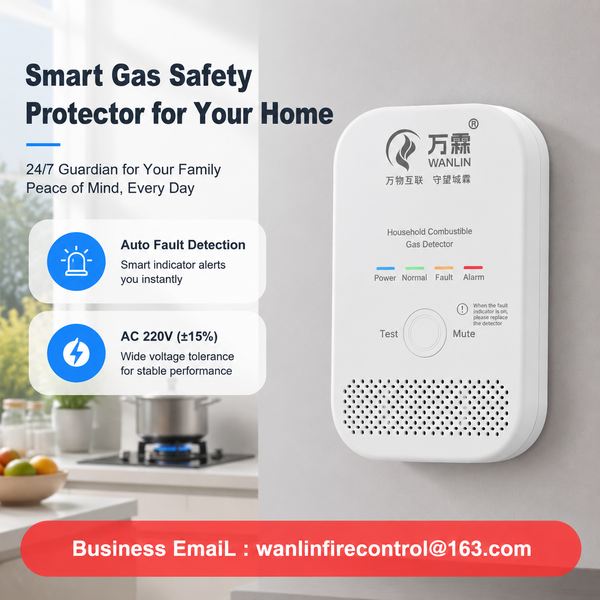
The CCCF gas detector is a professional-grade 4G gas detector engineered and manufactured by Wanlin Fire Control at our ISO9001:2015 certified production facility in China. The device integrates advanced catalytic combustion, NDIR infrared, or electrochemical gas sensing technology for reliable and false-alarm-resistant gas detection with 4G Cat.1 cellular connectivity enabling instant remote alerting to smartphones, cloud platforms, and monitoring centers. A critical integrated feature is the automatic solenoid valve control output - when gas concentration exceeds the alarm threshold (typically 7% LEL for combustible gases per EN50194), the detector simultaneously sounds an 85dB+ audible alarm, sends instant remote notifications via 4G, and activates the connected solenoid shut-off valve to stop gas flow at the source. Designed and certified for residential, commercial, and light industrial applications, the device meets or exceeds the requirements of multiple international gas safety standards including EN50194 (European Standard for Electrical Apparatus for Detection of Combustible Gases in Domestic Premises), GB15322 (China National Standard for Combustible Gas Detectors), and CCCF mandatory product certification.
The CCCF gas detector is a professional-grade 4G combustible gas detector designed and manufactured by Wanlin Fire Control. It integrates advanced gas sensing technology with 4G Cat.1 cellular connectivity, automatic solenoid valve control, and robust physical design for reliable gas leak detection in residential, commercial, and industrial applications. Below are the complete technical specifications:
Wanlin Fire Control, headquartered in Shaanxi Province, China, is a specialized and dedicated manufacturer of professional gas detection and fire safety equipment with over 15 years of continuous production experience. Our modern 20,000+ square meter manufacturing facility operates under ISO9001:2015 certified quality management systems, staffed by a skilled workforce of 200+ employees including 15+ dedicated research and development engineers focused exclusively on gas detection and fire safety product innovation. We are a genuine manufacturer - not a trading company, not a reseller, not an intermediary. Wanlin directly controls and executes every critical stage of the production process: gas #rega:433# selection and procurement from Tier-1 Japanese and European sensor manufacturers (Figaro, Nemoto, SGX Sensortech), electronic circuit design and PCB layout optimized for gas detection signal processing, surface-mount technology (SMT) PCB assembly on automated production lines, precision injection molding of detector housings in flame-retardant ABS, gas sensor calibration using NIST-traceable certified reference gas standards in our in-house calibration laboratory, final product assembly with 100% calibration verification and functional testing of every single unit before shipment, and export-grade packaging designed for international logistics.
Key Reasons to Source CCCF gas detector from Wanlin Fire Control:
For gas safety equipment distributors, importers, wholesalers, gas utilities, and project buyers, selecting a gas detector manufacturing partner is one of the most consequential strategic business decisions. The manufacturing partner you choose determines: your product quality and detection accuracy, your cost structure and margin profile, your brand-building potential (OEM/private label), your regulatory compliance in target markets, your supply chain reliability, and your long-term business scalability. When comparing across all dimensions - sensor quality, calibration accuracy, certification authenticity, pricing, OEM flexibility, solenoid valve integration, and partnership approach - Wanlin Fire Control demonstrates clear and compelling competitive advantages over both premium international brands (Honeywell Analytics, MSA, Drager, Kidde, X-Sense) and lower-tier Alibaba manufacturers.
Why Source 4G Gas Detectors from Wanlin Instead of Premium Western Brands: The fundamental technology of gas detection is well-established and standardized internationally - EN50194 (European Standard for Electrical Apparatus for Detection of Combustible Gases in Domestic Premises) and GB15322 (China National Standard for Combustible Gas Detectors) both define core detection principles based on catalytic combustion, semiconductor, or infrared absorption by target gas molecules. A catalytic or NDIR gas sensor calibrated in Wanlin's ISO9001:2015 certified factory performs the identical gas detection function as a sensor in a Honeywell, MSA, Drager, or Kidde detector - the physics and chemistry of gas detection is universal and does not discriminate by brand name or country of origin. The premium you pay for established Western brands primarily covers: brand recognition built through decades of marketing, multi-layer distribution costs (each layer adding markup), and corporate overhead. When you source from Wanlin, you pay exclusively for: the manufacturing quality (ISO9001 certified, 100% calibration and functional testing per unit using NIST-traceable reference gas standards), the genuine international certifications (all verifiable on official databases), the product engineering (15+ dedicated R&D engineers specializing in gas detection), and the product itself. For distributors, this fundamental difference translates directly to: competitive pricing that wins business even in price-sensitive markets, healthy distributor margins of 40-60%, and the strategic option to build your own brand equity through OEM manufacturing.
Additional Differentiating Competitive Advantages of Wanlin CCCF gas detector:
Large-scale residential gas detector deployment: (A) Planning phase - conduct building survey: count units with gas appliances, identify gas types per unit (piped natural gas vs. LPG cylinders), determine mounting heights (natural gas units: 30cm below ceiling; LPG units: 30cm above floor), document wall types (drywall/concrete/brick - determines mounting method), verify 4G signal strength on all floors with walk-through test, determine SIM card strategy (individual SIMs per detector or pooled data plan). (B) Installation - mount detectors at correct height for gas type, 1-3 detectors per apartment depending on gas appliance locations (kitchen mandatory, boiler room/heater closet if applicable), solenoid valve installation on main gas supply pipe for each unit, connect detector relay output to solenoid valve, wire to power (DC12V adapter or PoE). Installers can complete 15-20 units per person per day for standard configurations. (C) Cloud platform setup - create building/floor/unit hierarchy, bulk-register devices by scanning QR codes (200 units takes 2-3 hours for one person), configure notification groups (notify unit occupant + building manager + 24/7 monitoring), set maintenance schedule with monthly automatic self-test reports. (D) Testing and commissioning - test every detector: verify alarm with test gas, verify cloud notification, verify solenoid valve closes and can be reset, document results in platform. (E) Training - train building management: cloud platform usage, alarm and fault response procedures, solenoid valve reset procedure, emergency protocols including gas utility company contact. (F) Wanlin deployment support: pre-configuration of devices at factory, on-site installation team training, remote support during deployment. For projects exceeding 500 units, Wanlin can provide on-site technical support engineer.
Yes, comprehensive monitoring station integration: (A) REST API - Wanlin provides full REST API for monitoring stations to: receive real-time gas alarm events (gas leak, fault, tamper, low battery, offline, valve fault), query individual or group device status on demand, retrieve event history for any time period, receive heartbeat/keep-alive signals. Complete API documentation, code samples, and sandbox test environment provided. (B) Protocol support: MQTT for real-time event streaming (lowest latency for critical gas alarms), SNMP traps for network management system integration, email/SMS forwarding (simplest integration method). (C) Contact ID protocol emulation - the cloud platform can translate Wanlin alarm events into Ademco Contact ID format (industry-standard protocol used by virtually all monitoring stations worldwide) for seamless integration without software changes. (D) Monitoring station partnership - Wanlin works with your preferred monitoring station: provide API documentation and sample code, set up test environment for integration testing (typically 1-2 weeks), support parallel monitoring during go-live transition. (E) Redundancy - dual-path notification: primary path is cloud platform to monitoring station API, backup path is direct SMS to monitoring station phone number. (F) UL certification - for UL-listed central station monitoring (US market requirement), Wanlin is pursuing UL listing for the cloud-to-monitoring-station signal chain. Contact us for current UL certification status and timeline.
Commercial kitchen deployment guidance: (A) Regulatory requirements - governed by local building/fire/gas safety codes, commercial kitchen ventilation standards (NFPA 96, EN16282), and insurance requirements. (B) Detector placement: main cooking line area - 1-2 gas detectors covering gas ranges, ovens, fryers, griddles (natural gas: ceiling mount; LPG: floor mount), combi ovens and steamers - natural gas detector near ceiling, gas meter room - 1 detector near gas meter/main shut-off valve, bar area - LPG detector near floor for bottled gas under-counter, banquet kitchen prep areas - detectors per gas appliance cluster. (C) Solenoid valve strategy: main gas supply - 1 large solenoid valve on main gas line entering kitchen, triggered by any kitchen detector and emergency shut-off button at kitchen entrance, appliance-level valves - optional individual valves per major appliance for selective shut-off. Manual reset required after any shut-off. (D) 4G advantage for commercial kitchens: eliminates need to run signal cables through finished kitchen walls and ceilings (massive cost savings vs. wired systems), rapid installation with minimal kitchen downtime, independent system (does not rely on building WiFi which may be congested), remote monitoring by restaurant chain headquarters across multiple locations. (E) False alarm management - commercial kitchen false alarms are costly (kitchen shutdown during service). Mitigations: catalytic sensor (more selective than semiconductor for cooking vapors), install detectors at recommended distance from direct cooking area, configurable time delay before relay activation, silence button for transient cooking events, heat detector backup (for fire detection separate from gas detection). (F) Post-shut-off procedure training - kitchen staff must be trained: ventilate kitchen (exhaust hoods on maximum), identify and eliminate leak source, wait for gas concentration to drop below alarm threshold, manually reset solenoid valve, relight pilot lights on all gas appliances, verify normal operation before resuming cooking. Laminated emergency procedure card posted in kitchen.
Tested for challenging environments: (A) Temperature - operating range: -10 to +55C for standard models, -20 to +60C for industrial variants. Tested in: Middle Eastern summer conditions (45-50C ambient), Northern European winter (unheated buildings, garages), tropical conditions (consistent 30-35C with high humidity). (B) Humidity - operating range: up to 95% RH non-condensing. Gas entry protected by sintered metal flame arrestor preventing condensation ingress. Not recommended for: steam rooms/saunas, outdoor unprotected installation (requires IP65+ weatherproof housing), areas with direct water spray (use IP67 rated variants). (C) Dust - IP42 standard (protected against objects >1mm). For dusty environments (cement plants, grain mills, woodworking): increase cleaning frequency (monthly vacuum), IP65/IP66 rated industrial variants available, sintered filter protects sensor from particulate ingress. (D) Corrosive atmospheres - critical sensor consideration: catalytic sensors susceptible to poisoning by silicones (sealants, lubricants, hydraulic fluids), halogens (refrigerants, solvents, PVC decomposition), sulfur compounds (H2S, SO2 in oil/gas, wastewater, pulp/paper). For these environments: select NDIR sensor (immune to poisoning), select ATEX/IECEx stainless steel housing (316L for offshore/marine), specify sensor protection filter. (E) Vibration and shock - tested for IEC 60068-2-6 transport vibration and operational shock. Screw-fixed mounting required for vibration environments. (F) Coastal/marine - standard indoor models not rated for salt spray. For coastal installations: IP65+ weatherproof housing, 316L stainless steel hardware, conformal coating on PCBs. (G) Wanlin provides environmental assessment for your specific application - send details to wanlinfirecontrol@163.com for a recommendation on appropriate sensor type, housing, and mounting.
Structured after-sales management: (A) Return policy - Wanlin accepts returns for: manufacturing defects (full refund or replacement including return shipping), shipping damage (documented with photos upon receipt - replacement shipped immediately), incorrect items shipped (correct items shipped immediately). Returns not accepted for: customer ordering error, installation damage (water damage, impact, sensor contamination from silicone spray/paint), normal sensor depletion beyond 5-year design life. (B) Warranty claim process - advance replacement model: customer reports issue to distributor, distributor performs initial diagnosis (power connected? sensor warm-up complete? valve wired correctly? test button responds?), if confirmed defect - distributor issues replacement from local stock immediately, distributor files warranty claim with Wanlin (form + photos + description), Wanlin approves within 48 hours and credits/replaces, defective unit returned for root cause analysis. (C) Common issues: continuous alarm = gas leak present (ventilate, check appliances, call gas company) OR sensor contamination (clean area, allow sensor to recover), random beeping = low power or sensor fault (replace battery/check power supply), valve not closing = check wiring connections, check valve compatibility, false alarm from cooking = relocate detector further from cooking area, solenoid valve stuck closed = check for debris, test manual override. (D) Escalation - email wanlinfirecontrol@163.com with customer name, device serial number, detailed description with photos/video. Technical team responds within 24 hours. (E) Quality tracking - every returned unit undergoes root cause analysis with corrective actions implemented in manufacturing. Distributors receive quarterly quality reports.
Comprehensive multi-channel multi-contact notification: (A) Notification methods - Push notification (mobile app iOS/Android, free, fastest delivery), SMS text message (to any mobile number worldwide, small per-message cost from SIM data plan), automated phone call (text-to-speech: Gas leak detected at [location name]. Evacuate immediately. Do not operate electrical switches. Call gas emergency services.), email notification (to any email address with event details, device ID, location, timestamp), API webhook (for monitoring centers or third-party systems). (B) Multi-contact configuration per device: primary contact (occupant/owner), secondary contacts (family members, neighbors, building manager), property management or landlord, central monitoring station, gas utility company (where partnerships exist). (C) Escalation logic - configurable: if primary contact does not acknowledge within 60 seconds, notify secondary contacts, if still unacknowledged, notify monitoring station. Acknowledgement via: app button, SMS reply (ACK), phone call keypress. (D) Test mode - installers can enable test mode during maintenance to suppress notifications to all contacts except technician. (E) Automatic self-test results logged silently - monthly self-test results visible in platform to administrator but do NOT send notifications to end users. Only test failures generate alerts. (F) Multi-language notification support: English, Chinese, Spanish, French, Arabic, Portuguese, Russian. (G) Notification reliability: multiple SMS gateway providers with automatic failover, multiple SMTP relays for email, Apple APNs and Google FCM for push notifications. Typical delivery: push notification within 3-5 seconds, SMS within 10-30 seconds, phone call within 15-45 seconds.
Key differentiators: (A) Genuine certifications - Wanlin holds legitimate, verifiable certifications (CCCF, EN50194, CE, RoHS, FCC). Our certification numbers can be verified on official databases (EU NANDO, China Fire Product Information Network, FCC OET). Many low-cost Alibaba suppliers provide fake, photoshopped, or expired certificates. (B) Genuine sensor components - Wanlin uses Tier-1 sensors from Japanese/European manufacturers (Figaro, Nemoto, SGX Sensortech). Low-cost suppliers use unbranded sensors of unknown origin with inconsistent sensitivity, drift, and short service life. (C) In-house manufacturing - Wanlin controls entire production in our own 20,000+ sqm ISO9001 factory: SMT PCB assembly, injection molding, product assembly, automated functional testing including gas calibration using certified reference gases, packaging. Most Alibaba manufacturers are trading companies sourcing from unknown workshops with no gas calibration capability. (D) R&D capability - Wanlin has 15+ dedicated R&D engineers. Firmware, hardware design, sensor integration, cloud platform all developed in-house. Typical Alibaba suppliers cannot provide firmware updates, bug fixes, custom gas calibration, or product improvements. (E) Quality control - ISO9001 certified QMS: incoming component inspection, in-process QC, 100% functional testing including gas response testing of every single unit (not batch sampling), batch sampling with extended burn-in. Low-cost suppliers often skip gas testing entirely. (F) International experience - Wanlin has legitimately exported to 50+ countries with understanding of different regulatory requirements, gas composition variations by country, and distributor business models. (G) Ongoing commitment: English-speaking support, spare parts for 5+ years, firmware updates (OTA), working warranty, regular quality reports, R&D investment. Contact wanlinfirecontrol@163.com to discuss becoming a Wanlin partner.
Wanlin is committed to environmental responsibility: (A) ISO14001 certified environmental management system - audited annually, covering all manufacturing operations. (B) RoHS 2.0 compliant - lead-free solder, no cadmium, mercury, hexavalent chromium, PBBs, PBDEs, or restricted phthalates. RoHS test reports from accredited laboratories. (C) REACH compliant - meets EU REACH regulation requirements for chemical substances (SVHC). (D) WEEE support - product packaging uses FSC-certified recyclable cardboard. End-of-life recycling guidance provided in user manual. (E) Sensor recycling - gas sensors contain precious metals (platinum, palladium in catalytic beads). Wanlin provides take-back program for end-of-life sensors: return to Wanlin for precious metal recovery and recycling. (F) Energy efficiency - ultra-low power design for battery models. 4G connectivity enables remote monitoring without physical inspection visits - instead of a technician driving to inspect 200 gas detectors monthly, all detectors self-report status remotely via cloud platform, reducing carbon footprint. (G) Long service life - 5-10 year sensor life reduces landfill waste. Replaceable sensor design (replace sensor only, not entire detector). (H) Gas leak prevention - the primary environmental benefit: preventing gas leaks that release methane (a potent greenhouse gas with 25-28x the global warming potential of CO2 over 100 years) into the atmosphere. A single undetected natural gas leak can release significant quantities of methane before discovery. (I) Sustainability documentation provided for tenders: RoHS/REACH certificates, ISO14001 certificate, conflict minerals declaration (CMRT template), carbon footprint estimate, end-of-life recycling guidance. Contact wanlinfirecontrol@163.com for complete sustainability documentation package.
Wanlin Fire Control has supplied professional 4G gas detectors with integrated solenoid valve control to distributors, importers, property developers, facility management companies, gas utilities, government agencies, and system integrators in over 50 countries spanning six continents. The following representative case studies demonstrate how international partners have successfully deployed Wanlin 4G gas detection products - from exclusive European distribution partnerships and Middle Eastern government gas safety programs to Southeast Asian LPG distributor networks and large-scale Indian smart city gas safety infrastructure projects.
Location: Germany / Poland / Czech Republic / Slovakia / Hungary
A well-established European gas safety equipment distributor (operating in Germany, Poland, Czech Republic, Slovakia, and Hungary) partnered with Wanlin as exclusive distributor for 4G gas detectors. The distributor had previously sold Honeywell Analytics and MSA gas detectors but was losing market share to lower-cost competitors. After evaluating samples from 8 Chinese manufacturers over 3 months, Wanlin was selected based on: (1) genuine EN50194 test reports verified through the EU Notified Body database, (2) consistent manufacturing quality across 5 sample batches ordered at different times including consistent gas sensor calibration accuracy, (3) competitive factory-direct pricing enabling 45-55% distributor margin while retailing 30% below Honeywell Analytics, (4) OEM capability - the distributor launched their own GasSafe 4G branded gas detector line with solenoid valve integration manufactured by Wanlin, (5) responsive technical support - Wanlin engineering team customized the gas calibration for Eastern European natural gas composition (higher nitrogen content). First-year results: 12,000+ units sold across 150+ active accounts (plumbing and HVAC wholesalers, gas appliance installers, property managers). The GasSafe 4G brand is now recognized as a quality mid-market option in Central Europe. Key success factors: investment in local certification using Wanlin base certifications, local-language marketing materials (Wanlin provided English source files for translation into German, Polish, Czech, Slovak, Hungarian), and positioning as German-engineered quality oversight + Chinese manufacturing efficiency.
Location: Australia
An Australian gas safety startup (Melbourne-based, founded 2023 by a former gas utility safety engineer and an IoT technology entrepreneur) built a nationwide distribution network for Wanlin 4G gas detectors. Australian context: natural gas is the primary cooking and heating fuel for approximately 5 million Australian homes, with LPG widely used in rural and remote areas. Gas safety regulations vary by state, but growing awareness of gas leak risks (several high-profile house explosions from gas leaks in 2023-2024) is driving voluntary adoption. The startup strategy: (1) partner with Wanlin for 4G gas detectors with solenoid valve control, (2) obtain RCM certification (Wanlin supported process), (3) target gas fitters and plumbers as primary installer channel (they install gas appliances and can easily add the detector at the same visit), (4) offer gas safety package - gas detector + solenoid valve + installation + compliance certificate at fixed price for homeowners, (5) build network of 80+ certified installation gas fitters across Victoria, NSW, and Queensland. Unique value proposition: insurance premium reduction of 5-10% documented with major Australian insurers for homes with monitored gas detection, and peace of mind for holiday homes and Airbnb properties (remote monitoring when property is unoccupied). Results after 12 months: 8,000+ detectors installed, 80+ installation partners, revenue growing 30% month-over-month, now the 2nd largest 4G gas detector provider in Victoria. Key success factors: plumbing/gas fitter channel (natural complementary sale during gas appliance installation), insurance incentive (quantifiable ROI for homeowners), and Wanlin support: competitive startup pricing, RCM certification support, product customization (Australian gas fitting standards compliance).
Location: Philippines
A Philippines-based e-commerce entrepreneur (Manila, operating on Lazada, Shopee, and TikTok Shop) built a successful online-first brand for Wanlin 4G gas detectors under the SafeGas PH brand (OEM manufactured by Wanlin). Philippines context: approximately 40% of Filipino households use LPG for cooking, predominately 11kg cylinders. Gas leak accidents from deteriorated rubber hoses (tropical climate accelerates rubber degradation) and improper regulator connections are a significant safety concern. Market gap: few connected gas detectors available in the Philippines market, and imported premium brands are prohibitively expensive for the mass market. Strategy: clean modern packaging design with Japanese sensor technology positioning, emphasis on 4G connectivity as unique selling point (most local competitors sell basic non-connected gas detectors), bundled offering - detector + solenoid valve + 1-year SIM data plan + cloud platform access for single price (simplifying purchase decision). E-commerce optimization: professional product photography (lifestyle images in Filipino kitchens), video demonstrations (unboxing, installation at correct height for LPG, solenoid valve connection, gas detection test with unlit lighter, app setup), keyword-optimized product titles (LPG gas detector, gas leak alarm Philippines, kitchen gas safety, etc.), competitive pricing at 1,799 PHP (approximately 30 USD - positioned between cheap non-connected detectors at 400-600 PHP and premium imports at 4,000-6,000 PHP), strong customer review strategy with 4.8 star average. Influencer marketing: partnered with 3 Filipino home safety/tech influencers on TikTok and YouTube - one viral review demonstrating live gas detection and automatic shut-off generated 300,000+ views and 3,000+ direct sales in 72 hours. WhatsApp-based customer support in Tagalog and English. Results after 10 months: 10,000+ units sold, #1 bestseller in Gas Detectors category on Shopee Philippines for 7 of 10 months. Wanlin support: low MOQ for first order (100 units), fast OEM turnaround, competitive pricing enabling mid-market price positioning.
Wanlin Fire Control is actively expanding our global distribution network for 4G gas detectors with integrated solenoid valve control and related gas safety products. We welcome long-term strategic partnerships with: established gas safety equipment distributors and wholesalers, electrical and building materials distributors seeking private-label opportunities, LPG and natural gas utility companies requiring certified detection for customer installations, security and safety system integrators and professional installers, property developers and facility management companies, e-commerce entrepreneurs and online retailers, government procurement agencies, and import/export trading companies specializing in safety equipment. We offer flexible cooperation models:
In comprehensive summary, the CCCF gas detector from Wanlin Fire Control represents the optimal strategic balance of professional gas detection quality, genuine and verifiable international certifications, competitive factory-direct pricing, integrated solenoid valve control capability, and manufacturing reliability for gas safety equipment distributors, importers, wholesalers, gas utilities, project buyers, and government procurement agencies worldwide. By sourcing directly from Wanlin's ISO9001:2015 certified manufacturing facility in China - engaging with the actual factory that designs, calibrates, and produces your gas detectors using Tier-1 Japanese and European sensor components - you secure: professional-grade 4G gas detectors featuring catalytic combustion, semiconductor, or NDIR infrared sensing technology with automatic solenoid valve control, genuine international certifications (EN50194, GB15322 with CCCF, CE, RoHS, FCC) independently verified by accredited testing laboratories, factory-direct pricing delivering 30-50% cost advantage compared to equivalent specification products from premium Western brands (Honeywell Analytics, MSA, Drager, Kidde, X-Sense), comprehensive OEM and private label manufacturing services enabling you to build your own gas safety brand, a reliable manufacturing partner with 15+ years of continuous production history, and dedicated long-term distributor support spanning certification assistance, gas sensor selection and calibration guidance, marketing material provision, technical training, and responsive after-sales warranty service.
Whether you are an established gas safety equipment distributor seeking to expand your product portfolio with competitive 4G wireless products, an LPG or natural gas utility needing reliable detection equipment for customer installations, an entrepreneur building a new gas safety brand, a property developer equipping residential or commercial projects, an e-commerce seller seeking a differentiated connected safety product, or a government agency procuring public safety infrastructure - Wanlin Fire Control is prepared and committed to being your reliable, quality-focused, and competitively priced manufacturing partner. Contact us today to discuss your requirements, request evaluation samples, and begin building a successful partnership.
Contact Wanlin Fire Control Today:
Email: wanlinfirecontrol@163.com
Phone/WhatsApp: +8613261677119
Website: www.wanlinfire.com
Factory-direct pricing, professional quality, genuine international certifications, worldwide delivery - partner with Wanlin Fire Control for your 4G gas detector manufacturing and supply needs.